
Reaction mechanisms
See how a reaction proceeds step by step instead of memorizing the product for one worksheet line.
AI tutor
Get help when you are stuck on reactions, mechanisms, and organic chemistry concepts. Chemistry AI explains the reasoning step by step and lets you ask follow-up questions as you study.
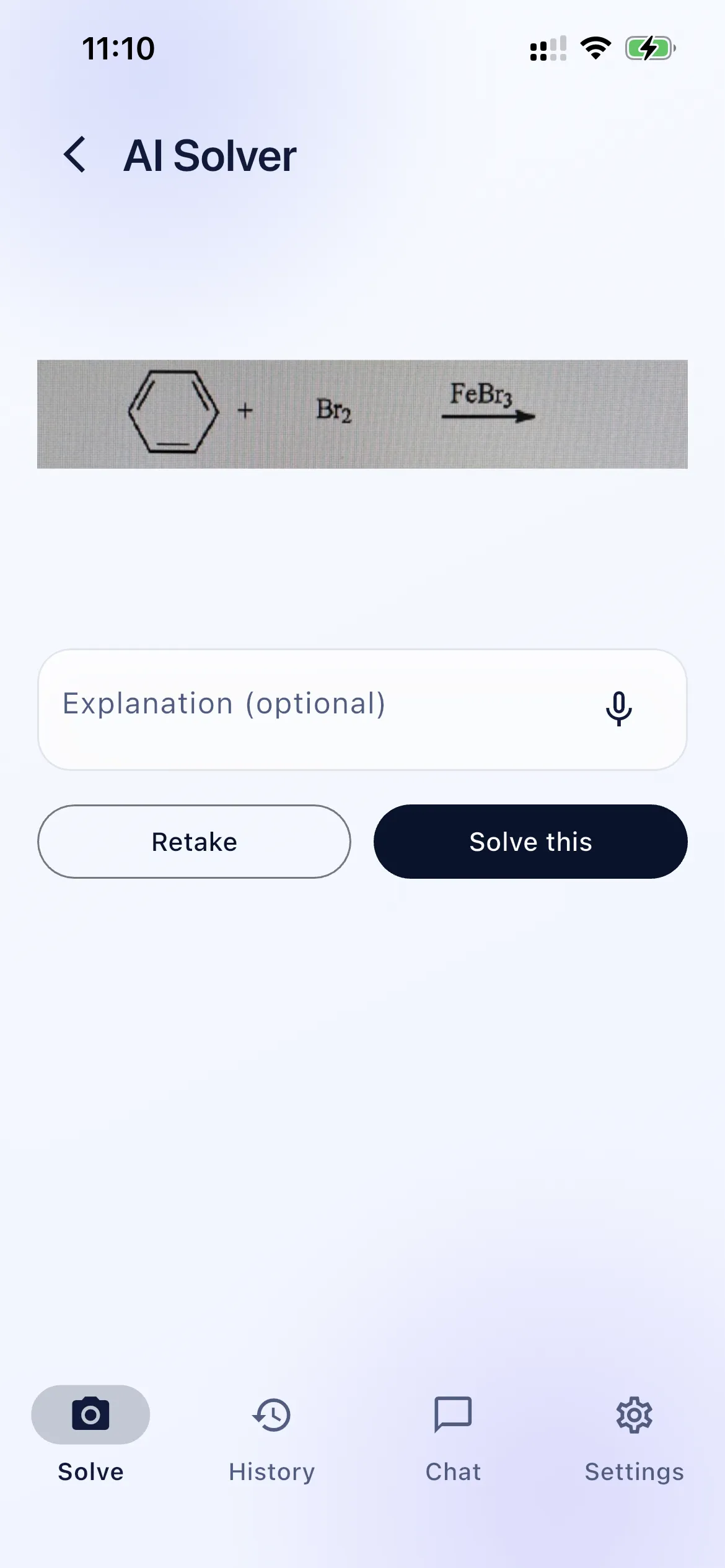
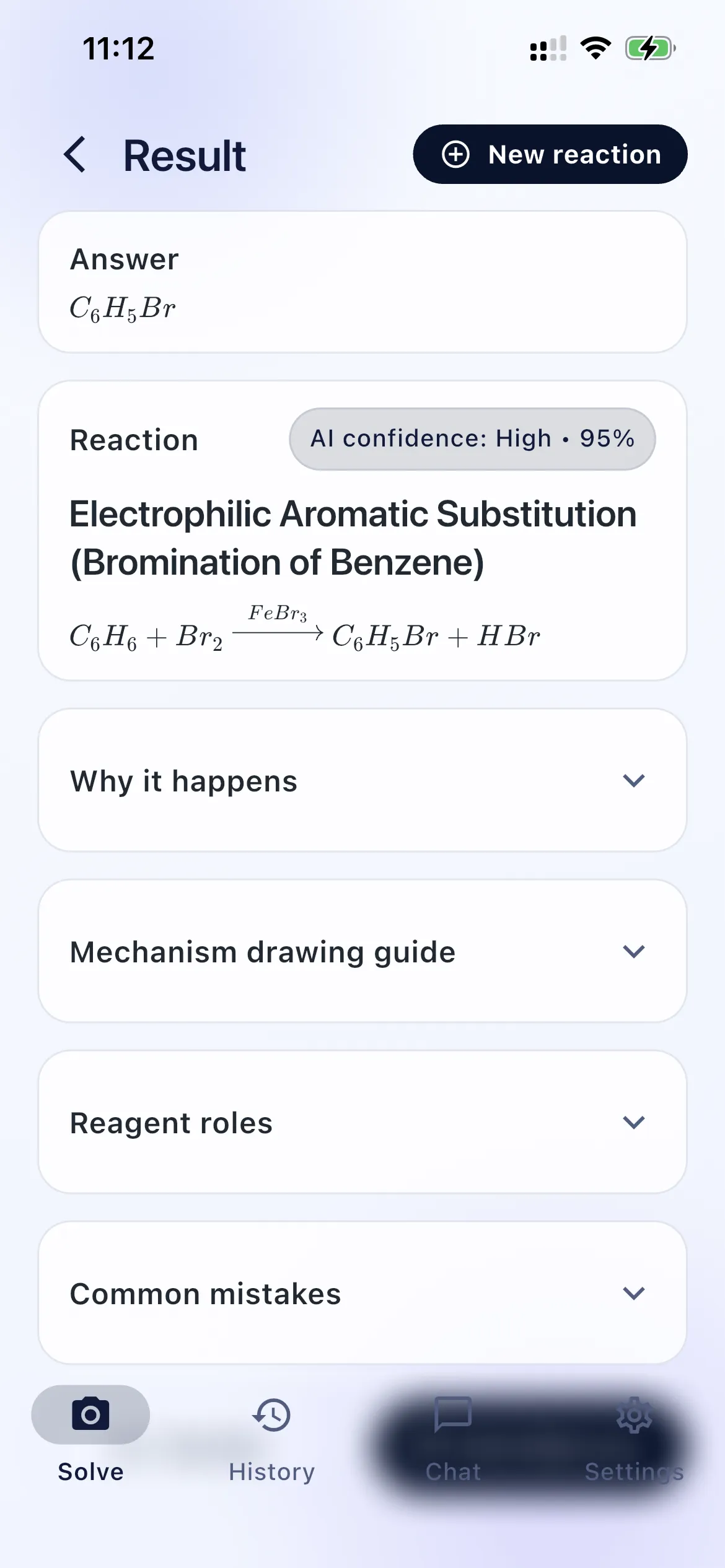
Knowing the product is often not enough. You may still need to explain why a bond breaks, where the nucleophile attacks, and how each curved arrow leads to the next intermediate — at 11 p.m., without office hours open.
Chemistry AI is an on-demand study companion for those moments — not a replacement for your professor, TA, or a qualified human tutor. For product-focused help, see organic chemistry AI and organic chemistry homework help.
See how a reaction proceeds step by step instead of memorizing the product for one worksheet line.
Follow where electrons start, where they move, and why each curved arrow is drawn that way.
Reason through which product forms from the reactants and conditions on the page.
Compare pathways when substrate, nucleophile, base, and solvent all matter at once.
Ask about nucleophiles, electrophiles, leaving groups, resonance, stereochemistry, and more.
Ask why a step happens or request another angle when the first explanation does not land.
Type the problem or photograph a single reaction from your notes or problem set.
See how Chemistry AI reads the scheme — reaction type, reagents, and what needs explaining.
Walk through each step, electron flow, and the mistakes that cost partial credit.
Stay in chat until you can explain why the favored pathway wins over the alternative.
Many problems require more than the final structure. You may need to defend why a nucleophile attacks one atom, why a leaving group departs, why one pathway beats another, whether a rearrangement is reasonable, and how stereochemistry changes along the way.
Chemistry AI is organized around that reasoning — reaction type, step-by-step mechanisms, and chat when one line in the explanation still does not match what you drew.
A useful tutor should help you understand why the reaction works.
(CH3)3CBr + H2O → ?
What reaction pathway is most likely — SN1, SN2, or elimination?
Tertiary alkyl halide, weak nucleophile (water), polar protic solvent — SN1 is favored. A tertiary carbocation forms; water attacks to give the alcohol after deprotonation. SN2 on a tertiary center is disfavored because of steric hindrance.
Step 1: C–Br bond heterolysis → tertiary carbocation + Br−. Step 2: H2O attacks the carbocation. Step 3: deprotonation → (CH3)3COH.
“Why would SN2 be less likely here?”
Because backside attack on a tertiary carbon is sterically blocked — the tutoring conversation continues until that constraint makes sense for the next exam question too.
Substrate class + nucleophile strength + solvent together predict the pathway — not the product alone.
Chemistry AI complements lectures, textbooks, office hours, and human tutoring — especially when you need help while you are studying, not only during scheduled sessions.
| Situation | Human tutor | Chemistry AI |
|---|---|---|
| Personalized discussion | Strong — adapts to your gaps in real time | Follow-up questions on supported problems |
| Immediate access | Depends on scheduling | On demand while you study |
| Reaction practice | Yes | Yes, for supported problems |
| Mechanism explanations | Yes | Yes, for supported mechanisms |
| Human judgment & course context | Yes | No — not a substitute for instruction |
| Cost | Often paid per session | Free tier + optional Pro subscription |
One reaction, one mechanism, as many follow-ups as you need.


Mechanism-first guides live on the reaction mechanism solver page. Product identification help is on the organic chemistry solver page. Topic notes (including the SN1 vs SN2 guide) appear under Learn and Tools.
Chemistry AI can provide step-by-step explanations on supported problems, walk through mechanisms, and answer follow-up questions while you study. It complements lectures, textbooks, and office hours — it does not replace them.
Yes. After you enter or photograph a problem, Chemistry AI breaks down the mechanism: bond changes, electron movement, and curved-arrow logic for each step.
Yes. After a solve, chat stays open so you can ask why a step happens, why another pathway is less likely, or which concept to review next.
Yes. Photograph a single reaction, crop the scheme, and work through the explanation. You can also type the problem if the reactants are already in your notes.
Students use it to compare pathways — for example why a tertiary halide favors SN1 with a weak nucleophile, or why a primary halide favors SN2. Ask follow-ups when two mechanisms look plausible.
No. Chemistry AI is an additional study resource for moments when you need immediate, step-by-step help. Human tutors and instructors still provide judgment, course context, and personalized feedback Chemistry AI cannot.
Yes — predict products before reading the explanation, redraw mechanisms from memory, and use follow-ups to drill weak reaction types until the reasoning feels automatic.
Work through reactions and mechanisms step by step, ask follow-up questions, and build a better understanding of organic chemistry with Chemistry AI.