
Solve organic reactions
Identify likely products and see how the reaction proceeds — not only what the major product is.
Organic chemistry AI
Solve organic chemistry problems and understand every step of the mechanism with AI built for organic chemistry students.
Generic AI tools often return a paragraph of text that sounds plausible until you try to draw the arrows. Organic chemistry is different: you need to know which bond breaks, where electrons move, and why one pathway beats another on the same page.
Chemistry AI is built around the workflows students actually struggle with — reactions, products, mechanisms, electron movement, and follow-up questions — not open-ended “do my homework” prompts. Snap one scheme, get a structured solve, then dig into the mechanism when the product alone is not enough.
For a deeper dive on product-first solving, see our organic chemistry solver guide. For arrow-by-arrow work, use the reaction mechanism solver page.
Identify likely products and see how the reaction proceeds — not only what the major product is.
Follow the mechanism step by step instead of stopping at the final structure on the page.
See why electrons move and how curved arrows should be drawn for each elementary step.
Photograph a reaction from a worksheet, crop to one scheme, and work through it on your phone.
Ask why a step happens, why another pathway is unlikely, or which concept you are missing.
Check your reasoning against a structured explanation before you turn in a problem set or sit an exam.
Snap a reaction, upload a photo, or type the reactants and reagents.
The solver reads the scheme, identifies the transformation where possible, and prepares the explanation.
Walk through electron movement, curved-arrow logic, reagent roles, and common mistakes.
Stay in chat until the step that confused you actually makes sense.
Organic chemistry gets hard when the exam asks why, not what. Which nucleophile attacks? Which bond breaks first? Where do the electrons go? Why is one mechanism favored over another? How does the final product form from that intermediate?
Chemistry AI is organized around that reasoning process — reaction type, step-by-step mechanism guidance, and chat when one line in the explanation still does not land.
The answer matters. The mechanism matters more.
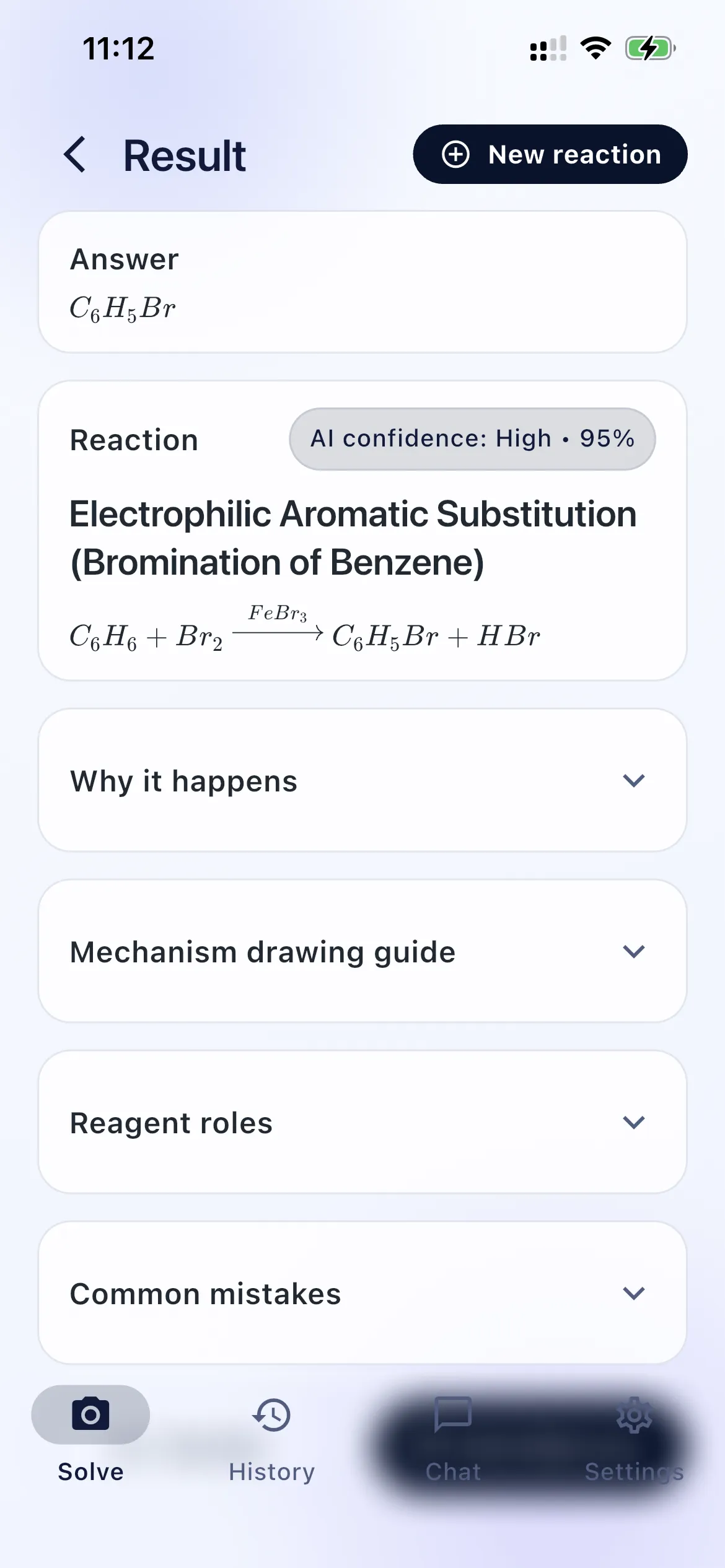
A typical workflow — electrophilic aromatic substitution — using a reaction many orgo courses cover early.
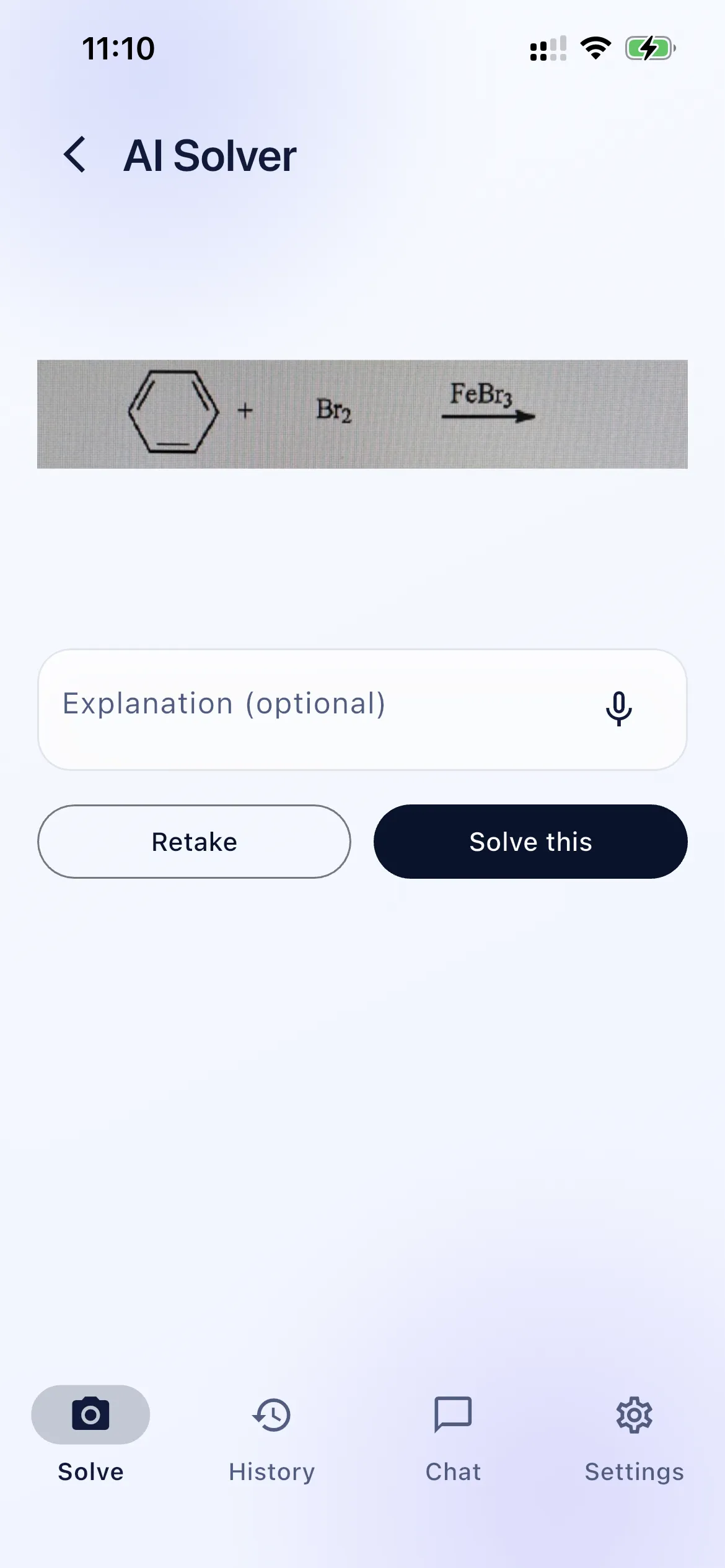
C6H6 + Br2 → ? (with FeBr3)
You photograph the scheme from a problem set or type the reactants in the app.
Chemistry AI recognizes electrophilic aromatic substitution: benzene reacts with bromine in the presence of a Lewis acid catalyst to install bromine on the ring.
The explanation walks through formation of the electrophile, attack on the aromatic ring (often shown with a resonance-stabilized intermediate), and restoration of aromaticity by loss of H+ — with curved arrows tied to each step.
Major product: bromobenzene (plus HBr). You can then ask follow-ups — for example why the catalyst is needed or how directing groups would change a disubstituted ring.
Free to try. One reaction, one mechanism, one follow-up question.


The useful moment is not the first answer — it is the third question. Chemistry AI keeps the conversation going after the solve, in the language of mechanisms and exams:
Topic guides live under Learn, including our SN1 vs SN2 guide. Interactive tools will sit under Tools.
Organic Chemistry AI is software built for organic chemistry students — not generic homework chat. Chemistry AI helps you analyze reactions, follow mechanisms step by step, and ask follow-up questions when a step still does not click.
Chemistry AI can help analyze supported organic chemistry problems: identify likely products, explain reaction type, and walk through reasoning. It is designed to teach the logic behind the answer, not replace your own work on graded assignments.
Yes. After a solve, Chemistry AI breaks down the mechanism: which bond breaks, where electrons move, and how curved arrows map onto each step. That is the core workflow, not an optional extra.
Yes. Photograph a single reaction, crop the scheme, and solve. You can also pick an image from your gallery or type the problem if you already know the reactants and reagents.
Students use it to check reasoning and fill gaps — for example whether your curved arrows match the pathway the reagents actually favor. It is a study tool; your course policies still apply to what you submit.
Yes, for understanding and practice: reaction types, mechanism steps, common mistakes, and follow-up questions that mirror what office hours sound like when you are stuck on one step.
No. Chemistry AI is supplemental — useful when you need a step-by-step walkthrough between lectures, problem sets, and office hours. It does not replace instruction from your instructor.
Get help with reactions, mechanisms, and electron movement whenever you get stuck.