
Learn organic chemistry
SN1 vs SN2: How to Tell Which Reaction Will Happen
SN₂ needs access to the reacting carbon. SN₁ needs a carbocation stable enough to form.
SN1 and SN2 are both nucleophilic substitution mechanisms: a nucleophile replaces a leaving group at carbon. The confusing part is that the same-looking starting material can behave very differently depending on the substrate, nucleophile, solvent, and steric environment.
The good news is that you do not need to memorize dozens of disconnected rules.
A much better way to think about the problem is:
SN2 needs access to the reacting carbon. SN1 needs a carbocation stable enough to form.
That one mental model explains most of the trends you are expected to recognize in introductory organic chemistry.
The 30-second SN1 vs SN2 answer
Use this order:
- Classify the carbon bearing the leaving group: methyl, primary, secondary, or tertiary.
- Check the nucleophile: strong or weak; bulky or unhindered.
- Check the solvent: polar protic or polar aprotic.
- Check steric hindrance around the electrophilic carbon.
- Use stereochemistry and rearrangements as clues if they are part of the problem.
Quick comparison
The mechanism explains the rules.
| Factor | SN1 | SN2 |
|---|---|---|
| Mechanism | Stepwise | Concerted, one step |
| Rate law | v = k[RX] | v = k[RX][Nu−] |
| Best substrate | Tertiary > secondary | Methyl / primary > secondary |
| Nucleophile | Often weak or neutral | Usually strong |
| Solvent | Polar protic | Polar aprotic |
| Intermediate | Carbocation | None |
| Stereochemistry | Substantial racemization | Inversion |
| Rearrangements | Possible | Not via carbocation |
Mental model: SN2 needs access. SN1 needs a stable carbocation.
Important: Real substitution problems can also compete with E1 and E2 elimination. A strong base, a hindered base, higher temperature, or a tertiary substrate may push the reaction toward elimination. This guide focuses on the logic that separates SN1 from SN2, but you should always ask whether elimination is also plausible.
The central idea: SN2 needs access, SN1 needs stability
Before memorizing solvent lists or nucleophile tables, understand what each mechanism physically requires.
SN2 needs direct access to carbon
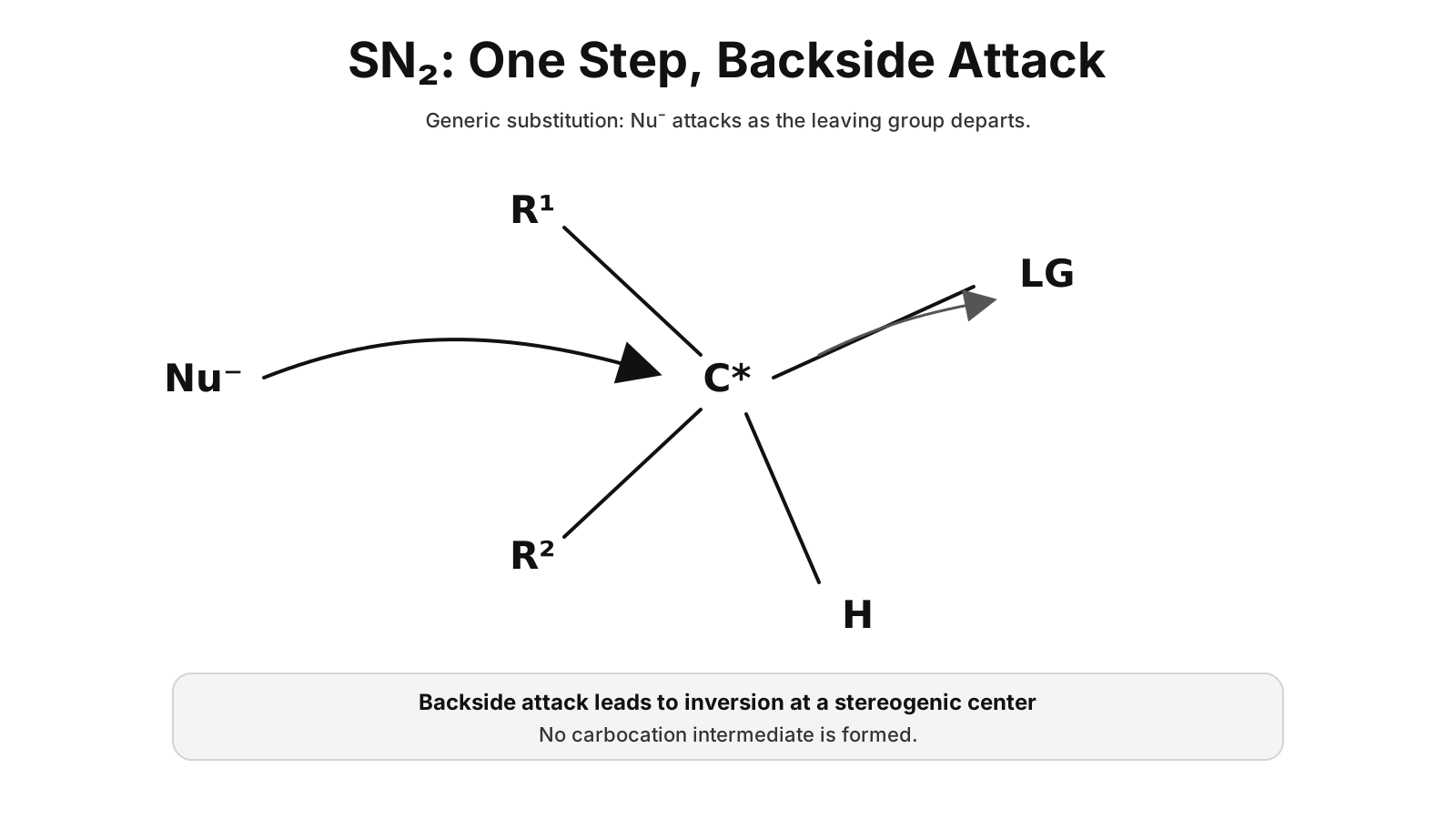
In an SN2 reaction, the nucleophile attacks the electrophilic carbon while the leaving group departs.
Everything happens in one concerted step.
That means the nucleophile must physically reach the carbon from the side opposite the leaving group. If bulky groups crowd that carbon, the approach becomes difficult.
So SN2 prefers:
- methyl and primary substrates
- strong, unhindered nucleophiles
- polar aprotic solvents
- low steric hindrance
Think:
SN2 = direct attack
SN1 needs a carbocation that can actually exist
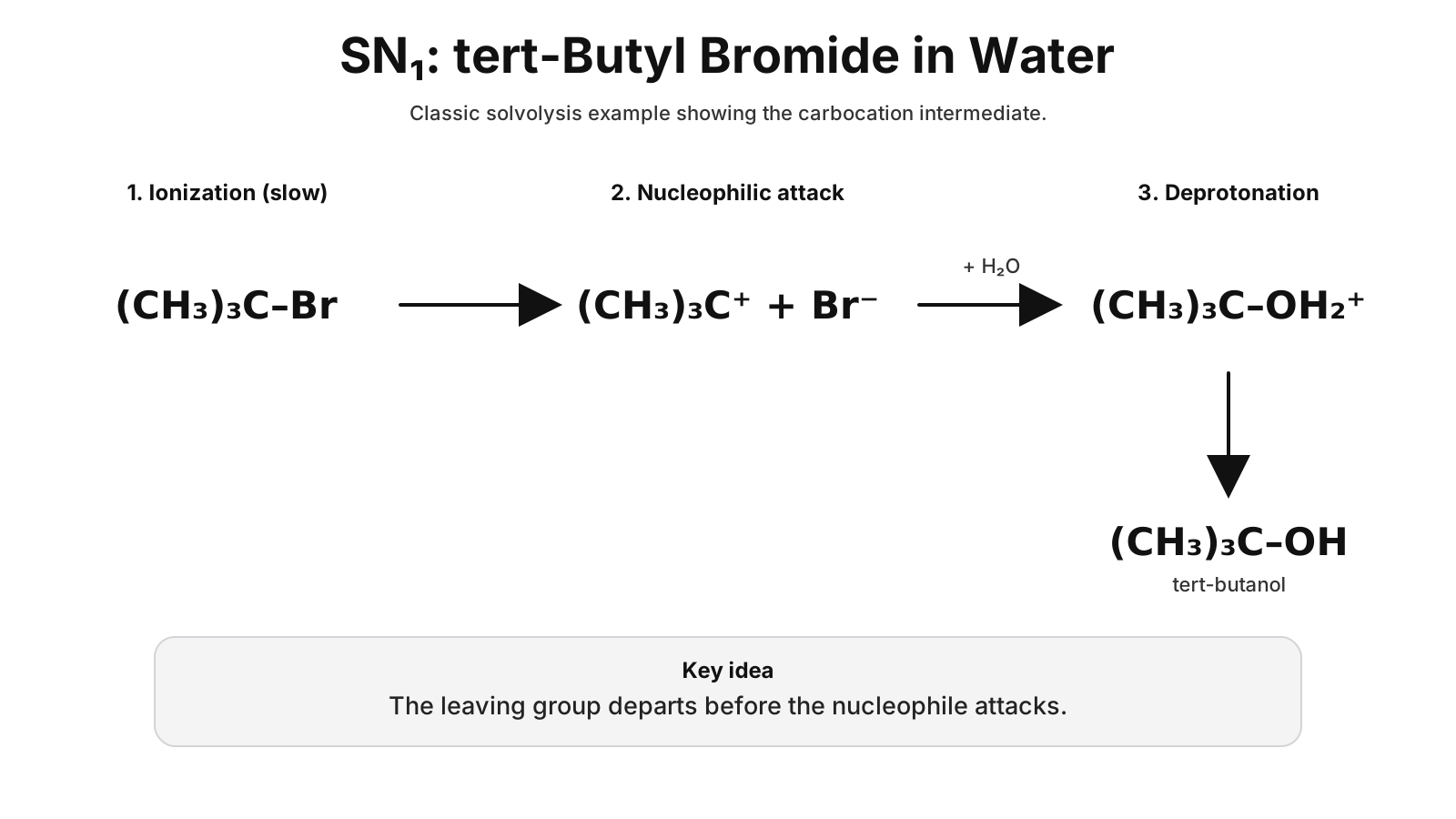
In an SN1 reaction, the leaving group departs first.
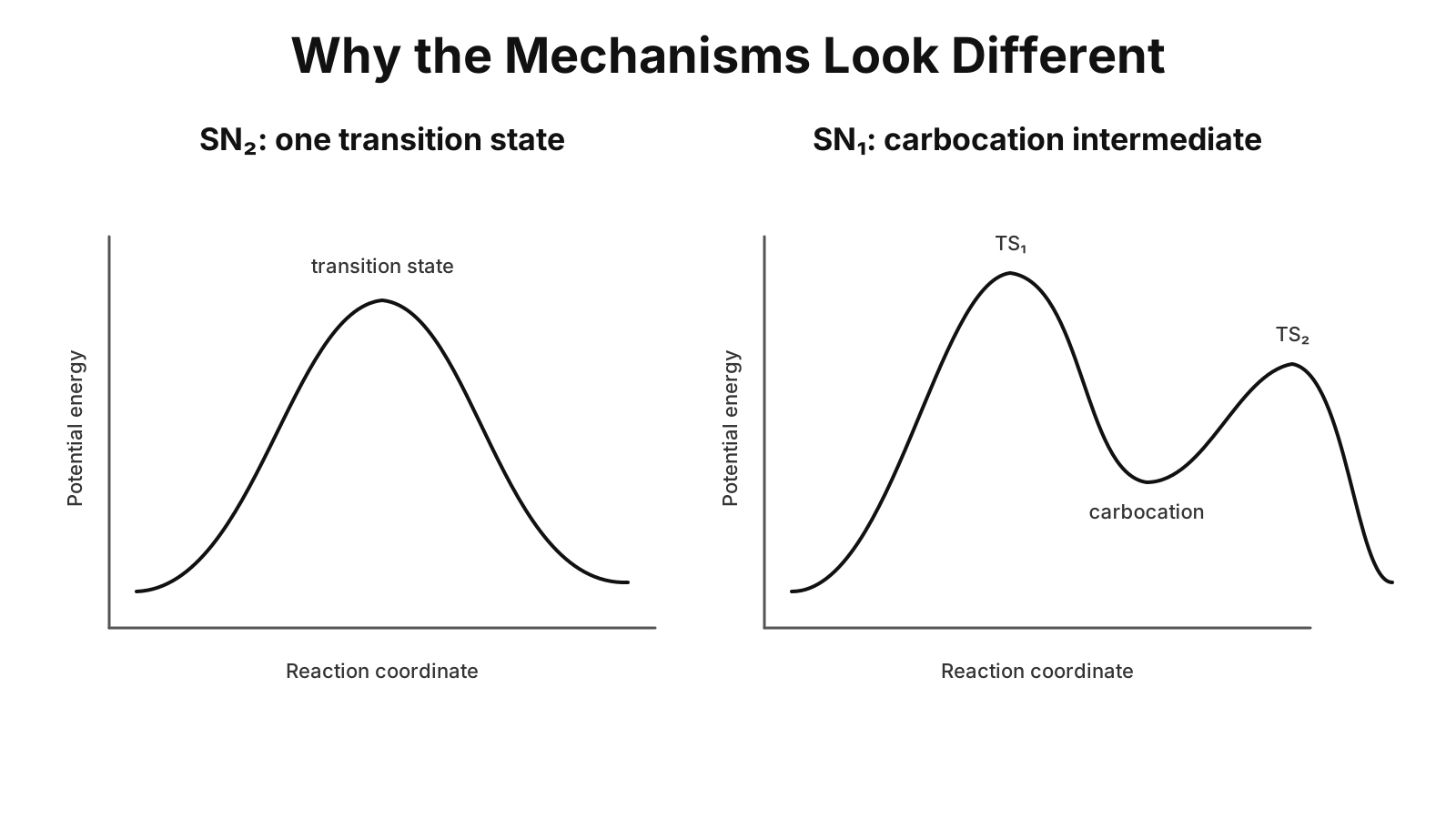
That creates a carbocation intermediate. The nucleophile attacks only afterward.
So the critical question becomes:
Is the carbocation formed by ionization sufficiently stabilized?
That is why tertiary substrates are much more compatible with SN1 than ordinary primary or methyl substrates.
SN1 typically prefers:
- substrates that can form relatively stable carbocations
- polar protic, ionizing solvents
- conditions where a strong nucleophile is not required
Think:
SN1 = leave first, attack later
Step 1: classify the substrate
Start with the carbon directly bonded to the leaving group.
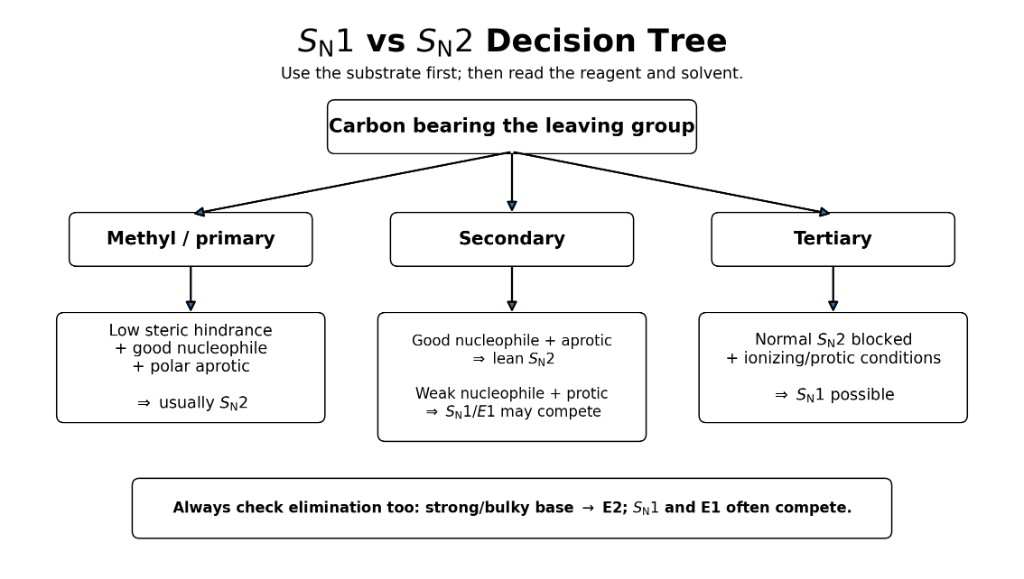
Do not begin with the nucleophile. The substrate usually gives you the strongest first clue.
Methyl substrates
A methyl substrate has the leaving group attached to a carbon bonded to no other carbons.
Example:
CH₃–Br
Methyl substrates are essentially ideal for SN2 because there is almost no steric hindrance.
A methyl carbocation would be extremely unstable, so normal SN1 is not a realistic pathway.
First instinct
Methyl → SN2
Primary substrates
A primary carbon is attached to one other carbon.
Example:
CH₃CH₂–Br
Primary substrates usually favor SN2 because the reacting carbon is still relatively accessible.
Ordinary primary carbocations are too unstable for a typical SN1 process.
First instinct
Primary → usually SN2
But remember the elimination caveat: a strong bulky base can favor E2 instead of SN2.
Tertiary substrates
A tertiary carbon is attached to three other carbons.
Tertiary substrates are highly crowded.
That makes backside attack extremely difficult, so standard SN2 is effectively blocked.
At the same time, tertiary carbocations are substantially more stabilized than primary carbocations.
First instinct
Tertiary → SN2 is strongly disfavored; SN1 becomes possible under ionizing conditions
Do not translate this into “tertiary always means SN1.” Strong-base conditions often favor E2.
Secondary substrates
Secondary substrates are where most students get stuck.
A secondary carbon is crowded enough to slow SN2, but a secondary carbocation can sometimes form under favorable conditions.
That means the reagent and solvent become much more important.
For a secondary substrate:
- good nucleophile + polar aprotic solvent → often pushes toward SN2
- weak nucleophile + polar protic solvent → SN1/E1 can become competitive
- strong base → E2 may dominate
This is why memorizing “secondary = ???” does not work.
You have to read the entire reaction.
Step 2: evaluate the nucleophile
Why SN2 cares about nucleophile strength
The nucleophile participates directly in the rate-determining event of SN2.
The rate law is:
v = k[RX][Nu−]
Both species matter.
A reactive nucleophile lowers the barrier to direct attack.
Common examples of useful nucleophiles in introductory SN2 problems include:
- CN⁻
- N₃⁻
- RS⁻
- I⁻
- Br⁻
- HO⁻
- RO⁻
The exact ranking depends on solvent, charge, polarizability, basicity, and sterics, so avoid treating any short nucleophile list as universal.
Practical rule
A good, relatively unhindered nucleophile supports SN2.
Why SN1 can work with a weak nucleophile
The nucleophile is not involved in the slow ionization step of SN1.
The rate law is:
v = k[RX]
That is why water or an alcohol can participate in an SN1 solvolysis even though they are much weaker nucleophiles than species such as cyanide.
Typical neutral nucleophiles/solvents include:
- H₂O
ROH
Practical rule
A weak or neutral nucleophile does not kill SN1 if carbocation formation is favorable.
Step 3: identify the solvent
The solvent changes the energetic environment of both the nucleophile and developing ions.
Polar protic solvents favor SN1 conditions
Polar protic solvents contain an O–H or N–H bond and can hydrogen bond.
Common examples:
- water
- methanol
- ethanol
These solvents can stabilize ions and help the ionization process needed to form a carbocation.
They also strongly solvate many anionic nucleophiles, which often reduces their nucleophilicity and slows SN2 attack.
Mental shortcut
Polar protic → supports SN1 / slows many anionic SN2 nucleophiles
Polar aprotic solvents favor SN2
Common polar aprotic solvents include:
- DMSO
- DMF
- acetonitrile
- acetone
They can dissolve ionic reagents without hydrogen-bonding as strongly to anionic nucleophiles.
The nucleophile therefore remains relatively reactive.
Mental shortcut
Polar aprotic → supports SN2
This is especially helpful in borderline secondary-substrate problems.
Step 4: inspect steric hindrance
SN2 is extremely sensitive to steric crowding.
The nucleophile must approach the electrophilic carbon from the backside, opposite the leaving group.
As the groups around that carbon become larger, attack becomes harder.
A useful qualitative order is:
methyl > primary > secondary >>> tertiary
for SN2 accessibility.
This steric requirement explains why a strong nucleophile still cannot simply force a normal SN2 reaction at a tertiary carbon.
The SN2 mechanism: one concerted step
SN2 stands for substitution nucleophilic bimolecular.
The essential event is:
Nu⁻ + R–LG → R–Nu + LG⁻
But the important part is that bond formation and bond breaking occur at the same time.
There is:
- no discrete carbocation intermediate
- one transition state
- backside attack
- inversion at a stereogenic reaction center
Why SN2 gives inversion
Because the nucleophile approaches from the side opposite the leaving group, the geometry at a stereogenic carbon flips.
This is called inversion of configuration, often called Walden inversion.
A useful exam association is:
SN2 → backside attack → inversion
The SN1 mechanism: carbocation first
SN1 stands for substitution nucleophilic unimolecular.
For a simple solvolysis, the sequence is:
- the leaving group departs
- a carbocation forms
- the nucleophile attacks
- if the attacking nucleophile is neutral, deprotonation may follow
The first ionization step is usually the slow, rate-determining step.
That is why the nucleophile does not appear in the SN1 rate law.
Example: tert-butyl bromide in water
A classic model reaction is the solvolysis of tert-butyl bromide in water.
Step 1: ionization
(CH₃)₃C–Br → (CH₃)₃C⁺ + Br⁻
The tertiary carbocation forms.
Step 2: water attacks
(CH₃)₃C⁺ + H₂O → (CH₃)₃C–OH₂⁺
Step 3: deprotonation
The protonated alcohol loses a proton to give tert-butanol.
The important conceptual point is not the exact molecule.
It is the order:
leave first → carbocation → attack
Stereochemistry: one of the best clues

SN2: inversion
At a stereogenic center, backside attack leads to inversion.
That is a strong mechanistic signature.
SN1: substantial racemization
A carbocation is approximately trigonal planar at the positively charged carbon.
That means the nucleophile can attack from either face.
Introductory courses often summarize this as racemization.
More precisely, real SN1 reactions do not always produce a perfectly 50:50 mixture because the leaving group and solvent environment can influence how accessible the two faces are. The useful exam-level concept is:
SN1 → substantial racemization / mixed stereochemistry
Rearrangements: another strong SN1 clue
SN1 reactions involve carbocations.
Carbocations can rearrange if a neighboring hydride or alkyl shift creates a more stable cation.
Typical rearrangements include:
- hydride shifts
- alkyl shifts
SN2 has no carbocation intermediate, so normal carbocation rearrangements do not occur.
A strong clue is therefore:
If you need a carbocation rearrangement to explain the product, a standard SN2 mechanism cannot be the pathway.
Worked example 1: primary substrate + cyanide
Consider:
CH₃CH₂–Br + CN⁻
in DMSO.
Ask the four questions.
1. Substrate
Ethyl bromide is primary.
That strongly supports SN2.
2. Nucleophile
Cyanide is a good nucleophile.
That supports SN2.
3. Solvent
DMSO is polar aprotic.
That supports SN2.
4. Steric hindrance
The reacting carbon is relatively unhindered.
Prediction
SN2
Cyanide attacks from the backside while bromide leaves.
The substitution product is CH₃CH₂CN (propanenitrile).
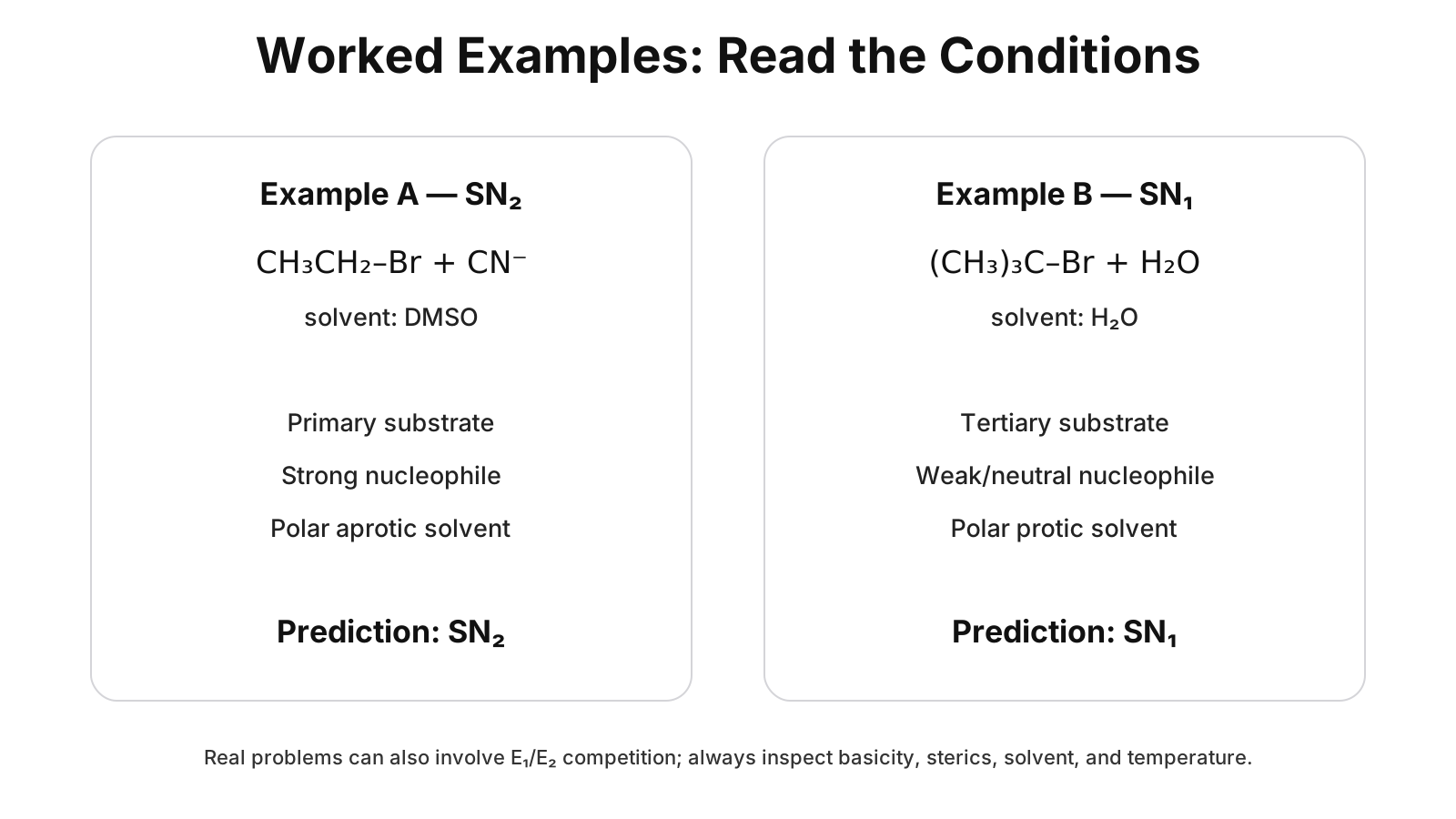
Worked example 2: tertiary substrate + water
Consider tert-butyl bromide in water.
1. Substrate
Tertiary.
That blocks standard SN2 and stabilizes the carbocation pathway.
2. Nucleophile
Water is weak and neutral.
That is compatible with SN1.
3. Solvent
Water is polar protic.
That supports ionization and SN1 conditions.
Prediction
SN1 substitution is plausible, with E1 as a possible competing pathway depending on conditions.
For the substitution route, the product after water attack and deprotonation is tert-butanol.
Worked example 3: the dangerous secondary case
Suppose you are given a generic secondary alkyl halide.
You cannot decide the mechanism from the substrate alone.
Compare two sets of conditions.
Case A: good nucleophile + polar aprotic solvent
A relatively unhindered nucleophile in DMSO or DMF can push the reaction toward SN2.
Case B: weak nucleophile + polar protic solvent
Water or an alcohol under strongly ionizing conditions can make SN1/E1 more competitive, particularly when the developing carbocation has additional stabilization such as allylic or benzylic resonance.
Lesson
Secondary substrates are where context matters most.
Do not memorize a single answer.
One detail students often miss: nucleophile vs base
A reagent can be both a nucleophile and a base.
That matters because a strong base may give E2 instead of substitution.
For example, a bulky alkoxide may be a strong base but a poor SN2 nucleophile because steric bulk makes attack at carbon difficult.
So after deciding that a reagent is “strong,” ask:
Strong at doing what—attacking carbon, or removing a proton?
This becomes especially important for secondary and tertiary substrates.
Special cases: resonance changes the normal substrate rules
The methyl / primary / secondary / tertiary framework is a powerful first pass, but organic chemistry has important exceptions.
Allylic and benzylic substrates
Carbocations adjacent to a double bond or aromatic ring can be resonance stabilized.
That can make SN1 more accessible than the simple “primary carbocations are unstable” rule would suggest in suitable allylic or benzylic systems.
SN2 can also be unusually fast at unhindered allylic or benzylic positions.
So if the reacting carbon is allylic or benzylic:
Do not stop at the primary/secondary label. Check resonance.
Aryl and vinyl halides
Ordinary SN1/SN2 rules for alkyl halides do not transfer directly to a leaving group bonded to an sp² carbon of an aryl or vinyl system.
Those substrates generally require different mechanistic reasoning.
The exam-ready SN1 vs SN2 decision process
Use this sequence rather than memorizing disconnected facts.
Question 1: What is the substrate?
Methyl
Strongly think SN2.
Primary
Usually think SN2, unless a different pathway is clearly favored.
Tertiary
Rule out normal SN2. Check SN1/E1 versus E2 conditions.
Secondary
Keep multiple pathways open and continue.
Question 2: What kind of reagent is present?
Ask:
- strong nucleophile?
- weak nucleophile?
- strong base?
- bulky base?
For SN1 vs SN2 specifically:
- good nucleophile → supports SN2
- weak neutral nucleophile → compatible with SN1
But a strong base should make you consider E2.
Question 3: What is the solvent?
- polar aprotic → strengthens the SN2 case
- polar protic → strengthens the SN1/solvolysis case
Question 4: Is the center crowded?
More steric hindrance hurts SN2.
Question 5: What mechanistic clues are in the product?
- inversion → points toward SN2
- carbocation rearrangement → points toward SN1/E1-type chemistry
- mixed stereochemistry from a stereogenic center → consistent with SN1
A better way to memorize the whole topic
Instead of memorizing this:
- tertiary means SN1
- primary means SN2
- protic means SN1
- aprotic means SN2
- strong nucleophile means SN2
- weak nucleophile means SN1
memorize two mechanistic needs.
SN2 asks:
Can the nucleophile get in and attack directly?
If yes, SN2 becomes more plausible.
SN1 asks:
Can the leaving group depart and leave behind a tolerable carbocation?
If yes, SN1 becomes more plausible.
Everything else modifies those two questions.
Common SN1 vs SN2 mistakes
Mistake 1: starting with the nucleophile
A strong nucleophile cannot overcome the geometric impossibility of backside attack at a heavily hindered tertiary center.
Start with substrate structure.
Mistake 2: treating “secondary” as a mechanism
Secondary is not a mechanism.
It is a signal to inspect the rest of the conditions carefully.
Mistake 3: forgetting elimination
A strong base may favor E2.
SN1 and E1 can also compete because they share a carbocation intermediate.
Mistake 4: ignoring solvent
Solvent can change the reactivity of the nucleophile and the ease of ion formation.
Mistake 5: drawing a carbocation in SN2
SN2 is concerted.
There is no discrete intermediate.
Mistake 6: forgetting stereochemistry
Backside attack means inversion.
Mistake 7: forgetting rearrangements
A carbocation may rearrange before nucleophilic attack.
Mistake 8: applying alkyl-halide rules to aryl or vinyl halides
Check hybridization and substrate class before applying the standard SN1/SN2 flowchart.
Quick checklist
When you see a substitution problem, ask:
- What carbon is attached to the leaving group?
- Is it methyl, primary, secondary, tertiary, allylic, or benzylic?
- Is the nucleophile strong, weak, bulky, or strongly basic?
- Is the solvent polar protic or polar aprotic?
- How hindered is backside attack?
- Can a stable carbocation form?
- Is elimination competitive?
- Does the stereochemistry reveal the mechanism?
- Would a carbocation rearrangement explain the product?
If you can answer those questions, you are no longer guessing between SN1 and SN2.
Practice problems
Try to predict the mechanism before opening each answer.
Practice 1
A primary alkyl bromide reacts with CN⁻ in DMSO.
Show answer
SN2 is strongly favored.
The substrate is primary, cyanide is a good nucleophile, and DMSO is polar aprotic.
Practice 2
tert-Butyl bromide is placed in water.
Show answer
SN1 substitution is plausible, with E1 competition possible.
The substrate is tertiary, standard SN2 is blocked, and the polar protic solvent supports carbocation formation.
Practice 3
What stereochemical change is expected when a clean SN2 reaction occurs at a stereogenic carbon?
Show answer
Inversion of configuration.
The nucleophile attacks from the backside.
Practice 4
Which substitution mechanism can involve hydride or alkyl shifts?
Show answer
SN1, because it proceeds through a carbocation intermediate.
Practice 5
A secondary substrate reacts with a strong bulky base.
Is “SN2 because the reagent is strong” a safe conclusion?
Show answer
No.
A strong bulky base may favor E2. Strength alone does not tell you whether a reagent will behave mainly as a nucleophile or base.
SN1 vs SN2 FAQ
What is the main difference between SN1 and SN2?
SN1 is stepwise and proceeds through a carbocation intermediate. SN2 is concerted: nucleophile attack and leaving-group departure occur in the same step.
Which substrates favor SN1?
Tertiary substrates are the classic SN1 case because they can form relatively stabilized carbocations. Secondary, allylic, and benzylic systems can also undergo SN1 under suitable conditions.
Which substrates favor SN2?
Methyl and primary substrates are most favorable because backside attack is relatively unhindered. Secondary substrates can undergo SN2 under favorable conditions. Tertiary substrates do not undergo normal SN2 substitution.
Which solvent favors SN1?
Polar protic solvents such as water and alcohols commonly support SN1 ionization.
Which solvent favors SN2?
Polar aprotic solvents such as DMSO, DMF, acetonitrile, and acetone commonly increase the reactivity of anionic nucleophiles and favor SN2.
Does SN1 always give a perfectly racemic mixture?
No. The simple teaching model predicts attack from either face of a planar carbocation, but real SN1 reactions often show substantial rather than perfectly complete racemization.
Does SN2 always invert configuration?
At the reacting stereogenic carbon, a clean SN2 mechanism proceeds by backside attack and gives inversion.
How do I distinguish SN1/SN2 from E1/E2?
Substrate structure, basicity, nucleophilicity, solvent, steric hindrance, and temperature all matter. Strong bases make E2 especially important, while SN1 and E1 often compete under carbocation-forming conditions.
Still unsure which mechanism your reaction follows?
Use the decision tree above and work through the substrate, nucleophile, solvent, and steric environment in that order.
Try the free SN1 vs SN2 predictor to walk through the same decision with instant feedback.
If you are working on a full organic chemistry problem and want to inspect the reaction mechanism and electron flow, solve an organic chemistry reaction with Chemistry AI.