
Reaction products
See what product is likely to form and which factors — substrate, reagent, solvent — push the outcome.
Homework help
Get unstuck on reactions, mechanisms, and organic chemistry problems with step-by-step guidance built for students — not a shortcut around learning them.
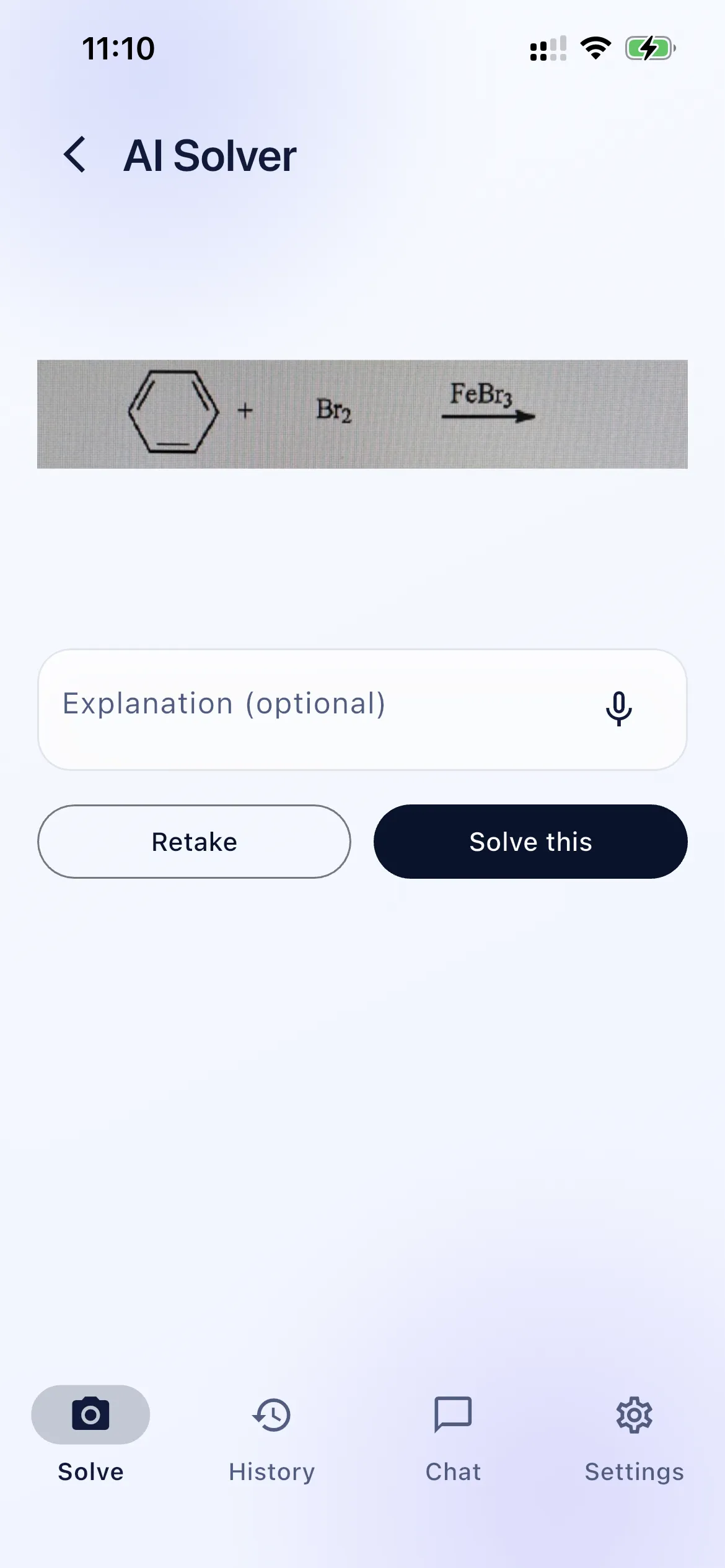
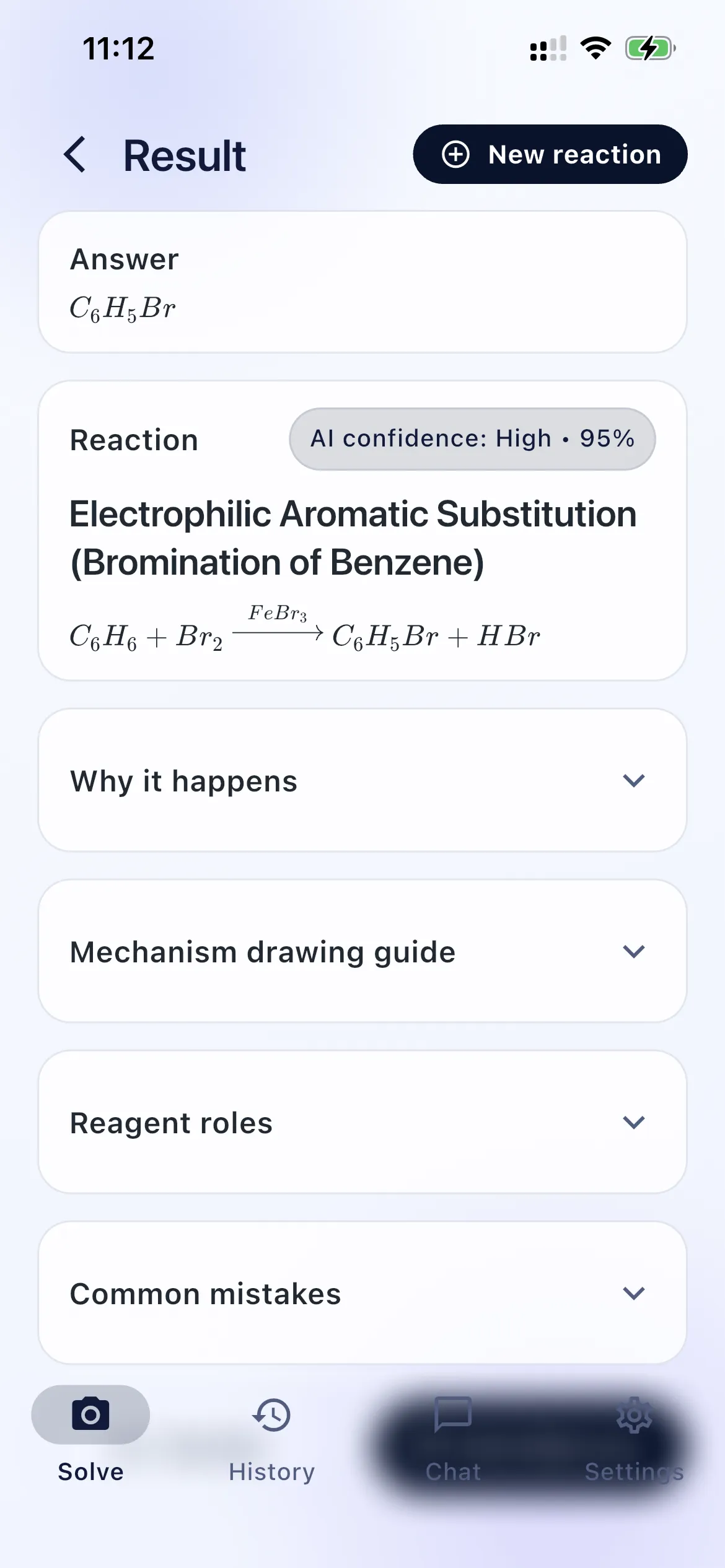
You may be able to identify the product but still lose points because you cannot justify the electron movement. Or you drew a mechanism that looks plausible until the charges stop balancing. That is normal — orgo homework is graded on reasoning, not only the final line.
Chemistry AI is built for that moment: one problem, a structured explanation, and follow-up questions when the step that tripped you up still does not make sense. For the broader organic chemistry AI workflow, see our dedicated guide.
See what product is likely to form and which factors — substrate, reagent, solvent — push the outcome.
Work through elementary steps and electron movement instead of memorizing the final structure.
Reason through competing pathways when more than one mechanism looks plausible on the page.
Break a target molecule into workable disconnections and check whether each step’s reagents make sense.
See where electrons start, where they land, and how each arrow matches a real bond change.
Ask follow-ups when a term, intermediate, or stereochemical detail still does not click.
Snap one reaction from the worksheet, upload a photo, or type the scheme if it is already in your notes.
Read the reasoning before you copy anything — product, reaction class, and what the reagents are doing.
Step through electron flow and compare it to the arrows you drew (or tried to draw).
Use chat for the one step that would cost you points: regioselectivity, stereochemistry, or competing pathways.
Close the explanation and redraw the mechanism on paper. That is where the homework actually sticks.
A common problem-set question — substitution on a primary halide — where the grade depends on the pathway, not only the product name.
CH3CH2CH2CH2Br + NaOH (aq) → ?
You photograph the line from the problem set or type the reactants in the app.
Primary alkyl halide, strong nucleophile (OH−), polar protic solvent — SN2 is favored over SN1 on a primary center; elimination is possible but disfavored relative to backside substitution here.
OH− attacks the carbon bearing Br from the backside; Br− leaves in the same step → 1-butanol with inversion at the stereocenter (if chiral). The takeaway: you can defend the pathway on the exam, not only circle the product.
Homework and exams reward pattern recognition, mechanism justification, and predictions on new combinations of reagents — not reciting a single product you saw once in lecture.
Chemistry AI keeps the explanation in that language: why this nucleophile, why this step order, why a competing pathway is unlikely. Use it to check reasoning, then redo the problem without looking.
Product-first help lives on the organic chemistry solver page. Arrow-by-arrow work is covered in the reaction mechanism solver guide.
Understand the pathway. Then put the phone down and draw it again.
Photograph a single reaction and work through the steps you were skipping.


The same question can do double duty if you change how you use the explanation:
Deeper topic notes live under Learn, including the SN1 vs SN2 guide. Practice utilities will sit under Tools.
Chemistry AI can help you work through supported problems step by step — products, mechanisms, and follow-up questions — so you understand the reasoning. It is meant for learning and checking your work, not for bypassing your course rules on graded assignments.
Yes. After you enter or photograph a problem, Chemistry AI walks through the mechanism: which bond breaks, where electrons move, and how curved arrows map onto each step.
Yes. Crop to a single reaction on the worksheet, solve it, and review the explanation. You can also type the problem if you already have the reactants written out.
Students use it to reason through competing pathways — for example whether a primary halide favors SN2 or whether a bulky base pushes elimination. Ask follow-ups when two mechanisms look plausible on paper.
Explanations are written in electron-pushing language: arrows start at electrons (lone pairs or bonds) and show where density moves in each step, so you can compare against what you drew.
Yes. Many students use the same problem twice: once to get unstuck, then again later to predict the product and draw the mechanism from memory before an exam.
No. Use Chemistry AI to understand a step you missed, check whether your arrows match the favored pathway, and practice explaining why — then close the app and redraw the mechanism on paper yourself.
Work through reactions and mechanisms step by step and understand why the answer makes sense.